image no longer in the archive
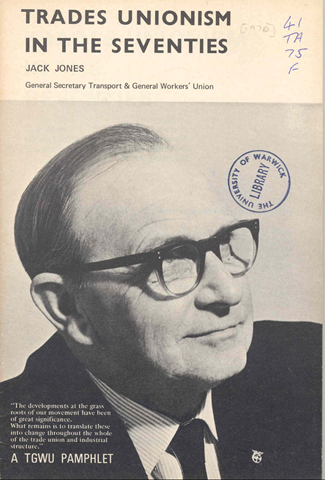
Jack Jones (March 1913 - April 2009) the former General Secretary of the Transport and General Workers Union (TGWU) died in April at the age of 96. He was general secretary for nine years from 1968 until 1978, writes Alan Thornett. During this period I was a prominent TGWU shop steward in the British Leyland (BL) Cowley car assembly plant and was involved in a number of very bitter battles with him. It was the time of the 1970s Labour governments, of which he was the chief, and for most of that time, the most effective defender.
I last saw him two and a half years ago in Kings College Hospital, London. I had just come through major surgery and was wheeled down to the main x-ray department and parked in the holding area. Five minutes later Jack Jones was wheeled in and parked at the other end.
There was too much history between us to cope with in that situation. We both bottled out and avoided eye contact until we were wheeled off again for our respective x-ray sessions. I reflected afterwards on how I might have reacted to this surprise encounter. “How’s your social contract Jack? Remember the ‘enemy within’? Do you still want to expel me from the union? Remember backing BL management against the shop stewards?”
For many years after he retired as TGWU General Secretary Jack Jones played a remarkable and unique role in the pensioners’ movement. No other retired union leader did this, as far as I know, and it should be fully acknowledged. And it is easy to look back today with nostalgia at the strength of the unions in the 1970s of which he was a part.
It would be disingenuous however to look at his role as TGUW general secretary, his period of greatest influence, without challenging the unstinting support he gave to the Labour governments of the 1970s against the rising tide of trade union militancy at that time. This support had a considerable effect on the trade union movement, all the more so because he was someone from and of the left of its ranks.
Jones was the son of a Liverpool docker. He fought in the Spanish Civil war, serving in the British Battalion of the International Brigade and was seriously wounded in the battle of Ebro in 1938.
After his return from Spain he was appointed local TGWU official for Coventry by Ernest Bevin. In 1955, with the departure of the right-wing anti-communist general secretary Arthur Deakin, Jones rose rapidly through the structures of the union. He was promoted to Midlands regional secretary and then, in 1963, to an assistant general secretary of the union by Frank Cousins. In December 1968 he was elected TGWU general secretary as the left-wing candidate.
His period of high office coincided with the strongest and most dynamic period of trade unionism in the post-war period in Britain. It was a time of the greatest advances in shop floor conditions, of the greatest growth of union membership and, above all, of the shop stewards’ movement. The TGWU itself exceeded 2 million members and the trade union movement as a whole reached 14 million. There was rising industrial militancy and important improvements won in wages and working conditions.
Jones’s commitment to defend Labour against industrial militancy had its origins in the battles against In Place of Strife in 1969 — Harold Wilson’s attempted legislation against the unions. In Place of Strife was withdrawn after a series of unofficial strikes against it. In return, a special conference of the TUC agreed that the unions would take on the militants in their own unions, thereby making legislation unnecessary. As the new general secretary of the TGWU Jack Jones was fully involved in, and committed to, that undertaking.
Wilson lost the election soon after and Edward Heath introduced the Industrial Relations Act, which itself engendered a major conflict with the trade union movement over the next four years.
During his time out of office Wilson sought to recast his fractious relationship with the union leaders since he knew he would need their support if he was to get back into office and stay there. A new body was formed called the TUC Labour Party Liaison Committee. Jack Jones and Hugh Scanlon — the new left-wing leader of the AEU — were its driving force.
When Labour came back to office in February 1974 after the miners defeated Heath, the Liaison Committee, with the Alternative Economic Strategy, sought to influence Labour policy from the left. They advocated, however, a “Social Contract” and this became a flagship Labour Government policy.
There were two aspects to the Social Contract. The first was voluntary wage restraint. The second was a broad commitment to cooperate with Labour and take on militant trade unionism and militant sections of the shop stewards movement to stop the so-called “disruption of industry”.
Given the level of militancy in the Cowley assembly plant in that period (the plant was averaging about 300 strikes a year) we always expected to be on the receiving end of any crackdown on strikes which might take place. We had been pilloried in the media for years as the worst example of “the British disease” — strike action and militant trade unionism. We were surprised, however, at the ferocity of it when it came and the degree of involvement of Jack Jones and the TGWU establishment in carrying it through.
I was the first target in Cowley. In March 1974 management withdrew recognition from me as a convenor and as a shop steward for allegedly calling strikes, leading strikes, encouraging strikes, and holding unauthorised meetings in the plant.
There was an immediate strike in my defence the following day the Financial Times carried a perceptive article which looked at the role of Jack Jones and the social contract in the dispute:
‘A dramatic initiative aimed at transforming the fortunes of its trouble-torn Cowley car Assembly Plant at Oxford has been taken by British Leyland, which has told the TGWU that it will no longer deal with one of its most senior and militant shop stewards.
This unusual step means that British Leyland is prepared to risk a prolonged shutdown of its Cowley works for the sake of curbing the power and influence of extreme left-wingers who have upset production at the Assembly Plant constantly in recent months...
This clash could lead to a major confrontation, which would have immediate implications for the “Social Contract” between the TUC and the Government. Mr Jack Jones, TGWU General Secretary, is closely identified with the Contract, which he has frequently insisted involves improving general industrial relations and efficiency as much as, if not more than, restricting wage increases.’
After a month of bitterly fought strike action a compromise settlement was negotiated by Moss Evans, the union’s national automotive officer. He was the only senior official of the union to support me at that time. I would be recognised as a shop steward but not in a senior capacity.
Sections of the TGWU establishment, however, wanted to go further than this. They ordered an inquiry into the dispute which they used to continue where management had left off. It was effectively an inquiry into who was responsible for strikes in the plant. It found that not just myself but that most of the leaders of the TGWU in the plant were guilty of supporting strikes and disrupting production.
The union ordered that we be removed from our elected positions forthwith and fresh elections held. We could stand, but under conditions of protracted media hysteria against us we stood no chance of winning. A bunch of right-wingers were duly elected in our place who unsurprisingly began to work hand in glove with management.
The election of the right wing was followed by the dismantling of the shop floor structures which had been the bedrock of trade union strength in the plant. The TGWU branch was split up while the joint shop stewards committee I chaired was effectively disbanded.
All this, in my view, reflected a wider shift to the right by the leadership of the union including Jack Jones. He was now, contrary to popular perception, shifting power in the union away from shop stewards and the shop floor towards full-time officials and the union establishment.
This view of Jones’s evolution at that time was not confined to the far-left. In his diary Against the Tide Tony Benn relates a discussion he had with Jones when he was Secretary of State for Industry. Jones argued strongly against him on the desirability of nationalisation! An astonished Benn asked him what this implied for British Leyland? Jones replied, ‘Why, couldn't you sell it?’ Benn asked, ‘To whom?’ ‘Why don't you sell it to General Motors?’, suggested Jones. Benn's conclusion was that the far left may well have been correct when they talked of Jones moving to the right.
In the summer of 1976 when there was a spate of strikes in BL, Jack Jones and Hugh Scanlon called a meeting of their national, regional, and local full-time officials representing their BL membership.
The speeches they made to this meeting could only be seen as a declaration of war on militant shop stewards whom they termed “the enemy within”. They urged the officials to work more closely with management and to stop strikes at all costs. Terry Duffy, the right-wing chief AUEW negotiator with BL, told the press afterwards: "If I find a politically motivated militant, I will deal with him." The idea that he and Jack Jones and Hugh Scanlon were not politically motivated, of course, was completely bizarre.
This again had a rapid impact in Cowley. A meeting of production workers had taken place in the North Works during the lunch break, to defend a young Asian worker who had been the victim of discrimination. (The right-wing convener of the plant Reg Parsons was refusing to represent him.) Next day management withdrew recognition from four North Works shop stewards saying that they regarded them as responsible for the meeting and therefore for seeking to disrupt the plant.
The North Works struck in their defence and next day the TGWU local official David Buckle, who had been at the meeting with Jones and Scanlon, called a mass meeting of the strikers and fought tooth and nail to get them back to work.
It was a remarkable meeting by any standards. Buckle and Parsons openly supported management's actions. They said that the four were political extremists controlled by outside organisations and were guilty as charged. Buckle told the meeting: ‘If you vote to support the stewards you will be voting for a long and bitter struggle ... the company have thrown down the gauntlet, if you vote to support the stewards you will be picking it up.’
They dramatically lost the vote, however, after the four addressed the meeting and won support. The strike continued for two weeks but was eventually isolated and defeated and the four were denied recognition until the left returned to the leadership of the plant and reopened their case.
As soon as the strike was broken TGWU officials ordered an inquiry into it. This was used to carry through a further damaging break up of shop floor organisation in the plant, again splitting up the TGWU branch and rendering it ineffective.
Twenty seven years later, in 2003, there was a remarkable sequel to this strike, which shed dramatic light on the pernicious role Buckle and Parsons had played in it. A file of documents was passed to us from a TGWU office which had closed down. It contained management’s record of the meetings with Buckle and Parsons during the strike over the four stewards and confidential correspondence between management and Buckle, including political profiles of the four stewards and the dossiers of “evidence” against them.
The file included management’s transcript notes of the report-back Buckle and Parsons had given them immediately after they had lost the vote at the mass meeting of the strikers. The notes show that they were not only fully supporting management but were openly urging them to stand firm against the strikers. In fact they were paranoid that management might make concessions to them. Parson had even threatened to resign as convener if any concessions were made.
Two weeks after the end of the North Works strike Jones and Scanlon addressed a second meeting of their full-time officials to review “progress”. After the meeting they appeared in Leyland's house magazine Leyland Mirror. They called on Leyland workers to stop strikes at all costs, "however justified they may be".
The right were unable to maintain majority support in the plant, however, and in December 1977, three and a half years after being removed from office, the left were dramatically elected back into the leadership. I was re-elected, though management still refused to recognise me.
The TGWU establishment were determined not to settle for this. No sooner had we been elected than we were ludicrously charged with disrupting a meeting of the Oxford District Committee of the union and of bringing the union into disrepute. Nine shop stewards from the plant, including myself and the TGWU convener, were recommended for disciplinary action. I was recommended for expulsion from the union.
There was a battle for months over these charges. Fortunately, by the time they had made their way through the procedures of the union Jack Jones had retired and Moss Evans did not want them pursued.
All this time, of course, Jack Jones had been the backbone of the government as far as incomes policy was concerned. At the TGWU conference in 1975 he had switched dramatically from being an opponent of incomes policy to an advocate of it. And in a huge battle with the left he had successfully proposed a £6 flat rate limit which became “phase one” of Labour's incomes policy.
Two years later, at the TGWU conference in 1977 which was Jones’s last before he handed over to Moss Evans, he attempted a repeat performance. Jim Callaghan, now in the pact with the Liberals, wanted to continue the incomes policy into a “stage three”. This, however, would have been very difficult without the support of the TGWU.
Although Jones fought might and main to deliver that support he was roundly defeated and a call for an immediate return to unfettered free collective bargaining was adopted against the platform. It was a massive victory for the left and threw Labour's wages policy into disarray. Healy was forced to introduce his phase three without TGWU and consequently TUC support.
Pressure for wage increases continued to escalate and by the time Healy announced his infamous “phase four” 5% wages limit in September 1978 it was not only without the support of the TGWU and the TUC but it was without either Jack Jones or Hugh Scanlon — who had now both now retired.
It was this combination of circumstances which triggered the winter of discontent during which 28 million days were lost in strike action and which smashed Labour’s incomes policy to pieces. Terry Duffy who followed Scanlon was far less effective and Moss Evans was far less committed to Labour policy. Evans, to give him his due, was prepared to implement the TGWU conference policy of free collective bargaining — at least in what he defined the “profitable” sectors of private industry.
Denis Healey was scathing about this. In His memoirs he says: “Moss Evans was a very inadequate substitute for Jack Jones as leader of the TGWU; he had no leadership qualities and little loyalty to the Labour Party”. By ‘no leadership qualities’ he means he was not adequately prepared to defy his members on behalf of Labour.
Of course not everything which has befallen the trade union movement since the defeat of the miners in 1985 can be put at the door of what Jack Jones did in the 1970s. But he was wrong in the idea that the union establishment could join with the employers against the militant sections of the movement without doing serious damage to the movement as a whole.
The idea that the authority of the unions was being undermined by militant action was completely misguided. The strength of the trade union movement was not based on the ability of its officials to get people back to work but on the militancy and confidence of the membership to take action in the first place. Destroy that and you destroy the strength of the shop floor movement and ultimately of the unions themselves.
Ultimately collaboration with management has a very dangerous logic. It strengthens the management and it strengthens the right wing within the movement. The actions of Jones and Scanlon in the mid-1970s played into the hands of Michael Edwards at the end of the decade in sacking tens of thousands of BL workers.
The tradition of collaboration was carried forward after Jones and Scanlon were gone by Terry Duffy — most spectacularly with his role in the sacking of Derek Robinson at the Longbridge car plant. This did huge damage to the unions in the auto industry which were the cutting edge of the movement at that time. It was one of the stepping stones for the Tories in preparing the ground to take on the miners.
1 comment
br parker · 17 August 2009
What a revelation.As one who was on the factory floor.the story of cowley iis made lucidly clear.None of the press stories stand up to thornetts logic. thank you.