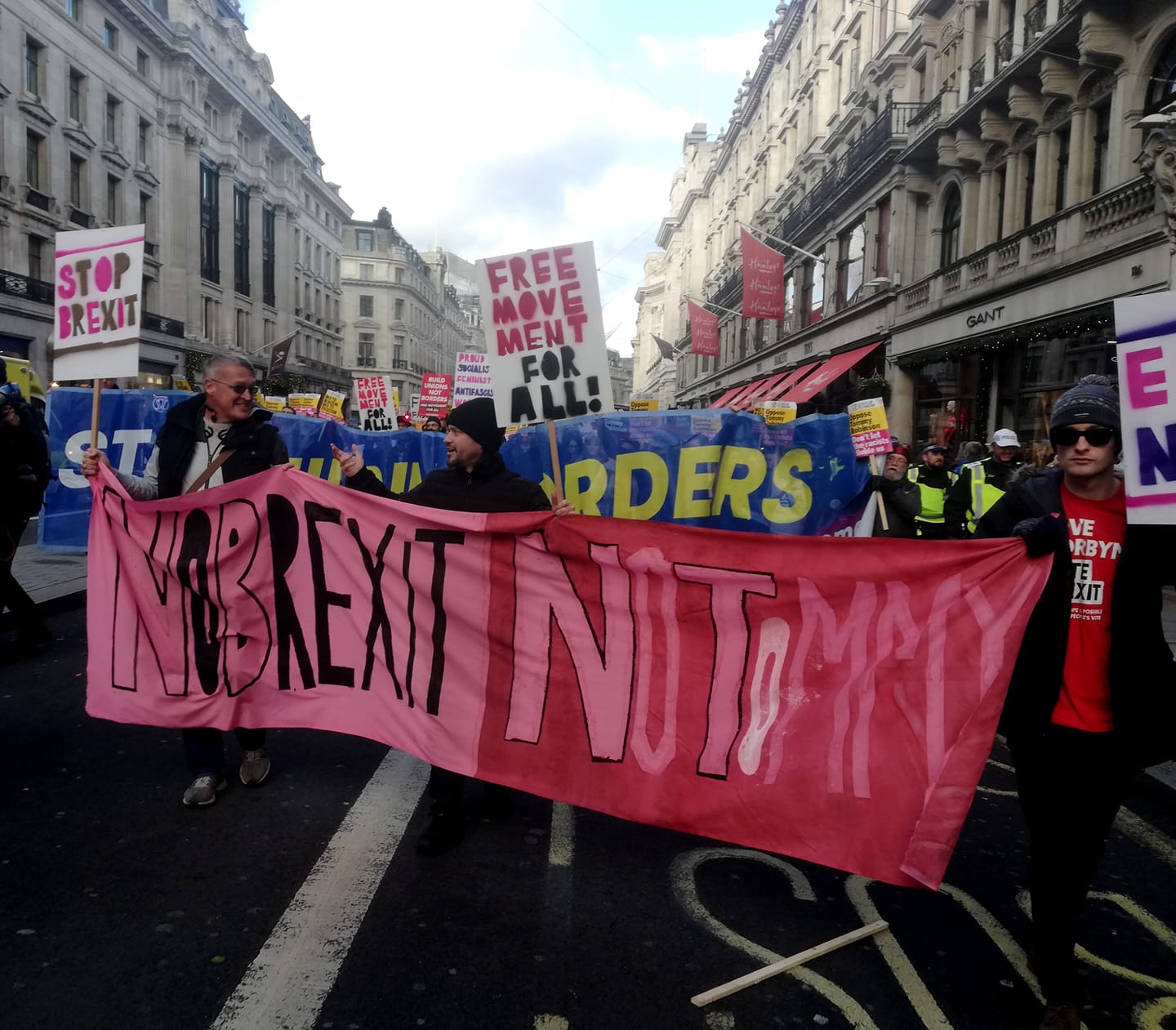
The Tories are in beyond a mess, writes Alan Davies. The fragile truce they put together last month when Parliament instructed Theresa May to reopen negotiations on the withdrawal agreement she signed with EU leaders on 25 November 2018, and get rid of the Irish backstop, was shattered when the European Research Group (ERG) withdrew their support and kicked Brexit even further down the road towards a no-deal crash out. (Their objection was that that the resolution contained the phrase ‘to give the Government more time’ and this could mean an extension to article 50. Who knows?)
It was another humiliating defeat for May and her chaotic Brexit policy and another step towards Tory self-destruction.
The debate on the new resolution was introduced by Stephen Barclay, the robotic Minister for leaving the EU, as May failed to attend. Anyone looking for any deviation from the policy of crashing out of March 29th in the absence of big and legally binding changes to the back stop, would be disappointed.
Barclay, with the ERG behind him, ploughed on; urging the Tories to ‘keep their nerve’. He maintained the ridiculous mantra that you need to keep a crash-out on the table as a threat, otherwise the EU will not negotiate seriously. But this was shot to pieces in the debate.
Caroline Lucas pointed out (devastatingly) that, since such a Brexit would damage the UK far more than the EU, it is like threatening to shoot ourselves in the head unless the EU agrees to our demands. Dominic Grieve said it was a like a three-year-old holding its breath to get its way.
There are, in any case, no negotiations. They finished in November. There are only polite discussions taking place on the understanding that they are not negotiations.
There was nothing in Barclay’s mind-numbing verbiage other than showing that it is the unswerving intention of the government to run down the clock until the last minute in the hope that MPs will be stampeded into voting for May’s position when they look over the cliff and see the rocks at the bottom with no time left to do anything about it. If that fails Britain would crash out onto WTO rules.
Will May keep her nerve in the end? We have to assume that she will, driven, presumably by the fantasies of the ERG and the hold it has on the Tory leadership. The consequences would be massive – even by today’s standards. Up to 7 Tory ministers have suggested that they might resign if a crash out became irreversible by government policy.
There remains, however, a conundrum, since the consequences of a Tory Government driving the country over the cliff could be catastrophic for the future of the government party itself. It could be the end of the Tory Party in its present form.
Labour’s role
Labour, however, faces dangerous times as well. Any idea that a Tory crisis on this scale could open up a big opportunity for Labour is excluded.
It is true that Keir Starmer made mincemeat of the Tories in his response to Barclay. He completely exposed the rundown to crash out and the shallowness of the Tory rhetoric.
But there was a serious problem. Labour’s standpoint remained pro-Brexit, albeit a soft rather than a hard one. It is not that there is no distinction between the two but that, in the end any Brexit in today’s conditions remains a Tory Brexit – a project of the right. The option of a left progressive Brexit does not exist – only (unfortunately) in the heads of most of the radical left in Britain including some of Corbyn’s key advisers to whom he appears to be listening.
It is just about possible, at the present time, to argue that the Brexit policy conducted by Corbyn remains in line with conference policy on Brexit – because the final crunch has not yet come. But it has become very difficult to have confidence that it will be carried out even when a second referendum becomes the only alternative to crashing out.
A second referendum has been absent from Jeremy Corbyn’s vocabulary when it should be a central ingredient. You could call it a backstop if you like – which was the way it was seen at LP conference.
It was deeply disappointing that a second referendum – which has massive support amongst Labour members particularly young members – was not in the letter he sent to May. This was only partly redressed by his letter to Labour members the following day.
It is difficult not to conclude from this that Labour is also running down the clock – in the hope that a Tory crisis at the final stages of all this will open the door to a Labour-led soft Brexit. But there is no form of Brexit on offer, including a soft Brexit were it possible, that will not leave people, especially the poorest or most vulnerable, worse off, both politically and economically.
There is now a serious danger that Labour could share the Brexit backlash. The Tories will only take sole responsibility a crash out they lead and the chaos that ensues if Labour lead an effective campaign against it, putting forwards credible measures to stop it happening. If a crash out happens, it would be disastrous if Labour, under a left leadership, were seen as complicit in the whole thing. Corbynism itself, under such circumstances, could be in grave danger.
Without the Labour leadership behind it, the campaign for a second referendum has been difficult. The fact that the campaign for it has been supported by many right-wing Labour MPs who have opposed Corbynism from the outset has understandably caused confusion.
A general election
At the moment a general election remains unlikely, since whatever they say in public, the Tory high command remain convinced that Corbyn would probably win it.
Last Sunday’s Mail on Sunday carried 20 pages of personal vilification of Jeremy Corbyn. On Tuesday, The Times had a front-page headline claiming that ‘the Tories would win a majority if election held today’. Maybe something was afoot.
The Times had commissioned a YouGov poll that had been carried out between 2 – 12 February which showed May making marginal gains. Labour would lose 12 seats and the Tories gain 4. The article recognises that this would still leave a seriously unstable government and admit that the Tories would have great difficulty working out what to say about Brexit in their manifesto. It is also worth remembering that Labour was 24 points behind the Tories when the last election was called. In fact, in looking at that poll, a majority Labour government would be a more likely outcome, given that Labour is a much superior campaigning organisation
But there is no guarantee that Labour will retain this level of support and how it conducts itself over Brexit is critical. Any election in the near future would be dominated by Brexit and if Labour were supporting even a soft Brexit, it would be likely to lose.
There is probably not a Commons majority for a second referendum at the moment, but that could change dramatically if Corbyn championed it. When the next parliamentary confrontations come, probably on February 27, the priority will be to get an extension to Article 50 to provide room to continue the battle. MPs need to take control of policy making away from the executive, But then, a second referendum must take centre stage, with the Labour front bench fully behind it.
The Labour leadership should put itself clearly at the head of the anti-Brexit movement which would consolidate Labours position in the general election and its long-term credibility. Not to do so strengthens the hands of the right inside the party and, even worse, seriously undermines the possibility of a Corbyn government.
3 comments
Gerry Downing · 17 February 2019
This is a well balanced article with which i have substantial agreement.
prianikoff · 18 February 2019
Chuck Umunna's 'Gang of 7' whole-heartedly support the People’s Vote campaign. He says it’s “been like getting blood from a stone getting the Labour party to do the right thing by our constituents on this issue”.
In reality a (second) People's Vote would probably lead to a coalition government, which is exactly what the deserters want.
Stephen Griffiths · 18 February 2019
I was on the street in Sparkhill Spark brook an innercity Stratford road District. The first two people to approach me were from Holland and had an African background.
On Saturday I ran out of flyers in favor of No to Brexit.
A big proportion of people I spoke to were women of Colour of all ages.
The youth understood that Brexit would not mean easier travel.
Roger Godsife record is papably bad he has been a Brexiteer.
Watch this space.