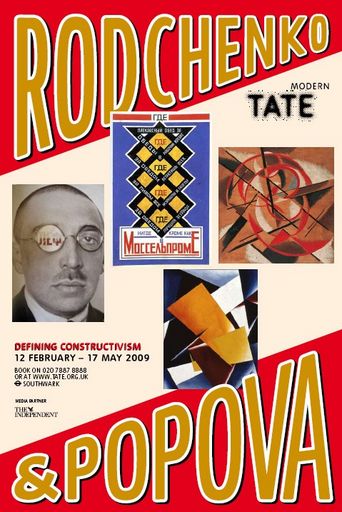
 1917 to 1924 in revolutionary Russia were years of war, famine and hardship followed by reconstruction. They also yielded a rich seam of artistic activity. A cultural avant garde emerged with an influence on western art, photography, theatre, cinema, architecture, design and advertising that still resonates today.
This major new exhibition - presenting works by the two leading figures of this “Constructivist” movement, Aleksandr Rodchenko and Liubov Popova - brings together some 350 paintings, models, posters, films, designs and other objects.
Its two halves mark the shift they made in 1921 from painting towards socially engaged artistic production. We see Rodchenko and Popova responding to and breaking from the Suprematism and Expressionism of the pre-revolutionary period. They developed a “Non-Objective” approach - non-representational abstract painting that, within three decades, was to predominate in western art. Painting was then abandoned altogether as they took their art into production and social transformation.
Little is said about how they existed in the difficult early years. But Bolshevik government support ensured that their art works were purchased by state and local museums, many of whom remain the owners today.
The environment certainly had its impact. After Popova gave birth to a son in 1918, her husband died of typhus in 1919, which also struck her. She and her son then died of scarlet fever in 1924.
Rodchenko’s life was more stable. His partner Varvara Stepanova was also a leading light in the Constructivists and a number of her works are also exhibited. But in the Stalinist 1930s he was excluded from the artistic establishment, accused of “bourgeois formalism”.
The Constructivists made their mark by setting up an “Association of Radical Innovators” which organised an exhibition in 1919. They then rose to dominance in 1921 through debates that pitted “construction” against “composition”, a dispute over the relationship between art and society. This culminated in “5x5=25”, a seminal exhibition by five Constructivist artists, three of whom were women, reproduced at Tate Modern.
The prominence of women and the respect they commanded is exceptional in western art history. The Constructivists were not explicitly feminist, but they were influenced by Bolshevik support for women’s emancipation. Their work, writing and lifestyle reflected a rejection of bourgeois stereotypes of “femininity”, an embrace of egalitarian ideals and an engagement with Bolshevik feminists like Aleksandra Kollontai.
From a contemporary perspective, some artefacts – like a poster “Male worker protect your sister from prostitution” – appear to reinforce rather than challenge stereotypes. But many others don’t.
From an early stage the Constructivists rejected the notion of artists as aloof from society, producing great works that are then commodified by the market. They sought to play a role in the reorganisation of everyday life and public spaces – lending an avant-garde aesthetic to the Bolshevik reconstruction.
Examples include the decoration of the Moscow Kafe Pittoresk, a bohemian cabaret, with abstract sculptures and paintings; the creation of a “workers' club” and designs for buildings, textiles, porcelain, books, films and stage productions. Rodchenko’s works shown include a poster for Eisenstein’s film The Battleship Potemkin about the 1905 revolution and a design for Trotsky’s book, Problems of Everyday Life.
Today’s eco-socialist artists may be less inclined to emulate his designs for an aircraft hangar or cigarette packets. And what should we make of the revolutionary advertising agency he set up with poet Vladimir Mayakovsky to promote “Red October” biscuits and other products of the new state enterprises?
A world apart from the Socialist Realism of the Stalinist era that followed, their critique of the relationship between art and society was based on constant experimentation and a rich cross-fertilisation of different disciplines.
Keen to break down the barrier between artist and society, they were interested in the relationship between “street life” and architecture, drama and public space. These themes were later developed by Walter Benjamin, Berthold Brecht and others and revitalised in post-1968 theatre and agit-prop. One example was Popova’s work with director Meirkhol’d in planning a “mass action” street spectacle to celebrate the Third Congress of the Third International in Moscow.
Christina Kaier, in an interesting essay on Bolshevism, feminism and art in the catalogue, credits Popova and Stepanova with developing an “NEP fashion” through a socialist, feminist take on clothing design. They addressed, she writes, “the multiple briefs of de-objectifying the female body, appealing to consumer tastes even while attempting to transform them and reinventing the material culture of everyday life under socialism”.
The exhibition suffers from a dearth of political context. A time line mentions the fact of the October revolution but no other event of political significance. This was a movement rooting art in society, but many visitors will leave none the wiser about the revolutionary society that produced the art.
As if to make up for this, Tate Modern have produced a magnificent new book of photographs, posters and other visual images of the Russian revolution by David King, especially for the exhibition - piles of which are on display as you leave. And the exhibition shop is stacked with works by Trotsky.
A rare chance to experience the living culture of the Bolshevik revolution.
An exhibition at Tate Modern, London SE1 until 17 May 2009 reviewed by Piers Mostyn